BackCase study
BodyMed Hub
The system a physiotherapy clinic runs on: booking, payments, waitlist, insight and team, in one Hub.
Sole developer, for BodyMed Healthcare, named Rehabilitation Clinic of the Year 2026 at the Irish Healthcare Centre Awards.
Live since .
- tests
- 438
- API routes
- 90
- scheduled jobs
- 9
39 pages · 8 architecture decision records · 20 modules live
The production code is private. The demo and its code are public, and run as a fictional clinic.
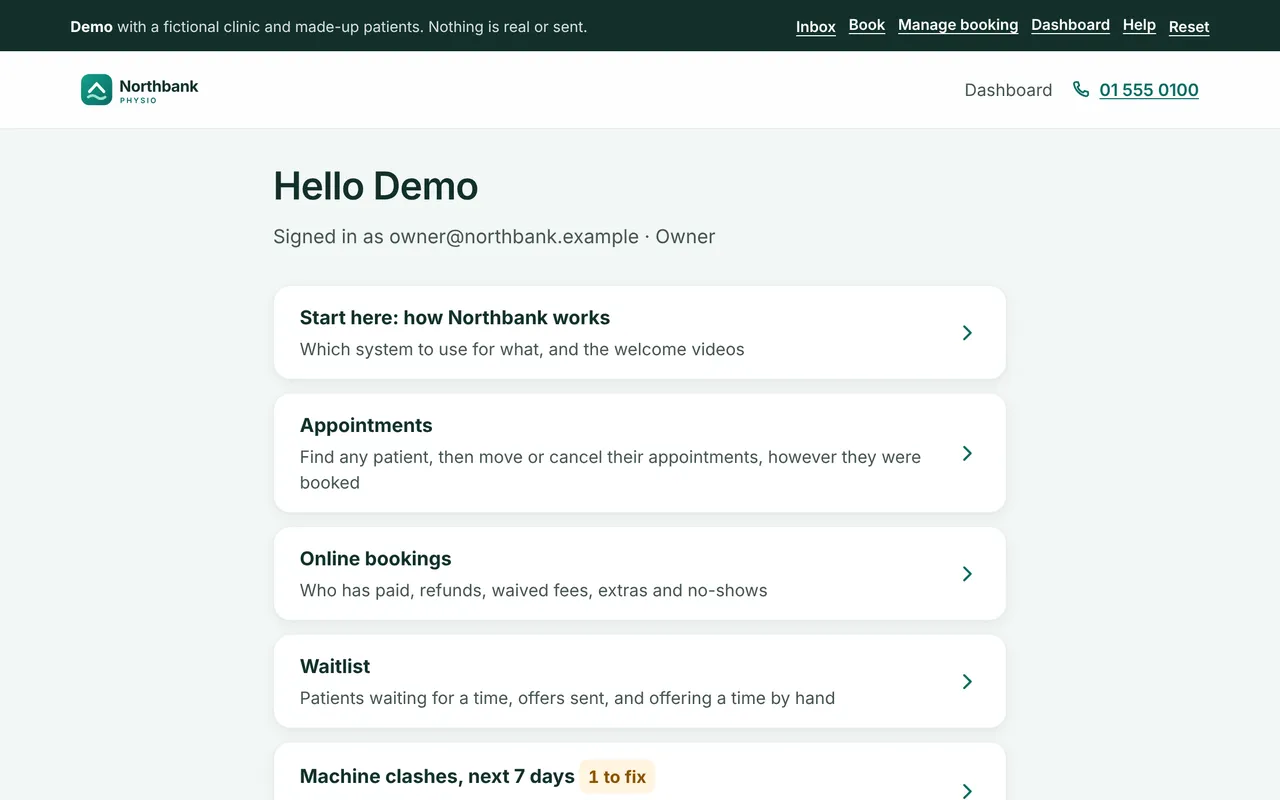
The Hub in the public demo. The clinic and everyone in it are made up.
What it replaced
What the clinic had before, and what does that job now.
- Before: Jane online booking, with no payment at bookingNow: Pay at booking, on Cliniko and Stripe
- Before: Manual phone paymentsNow: Pay links and saved cards
- Before: No equipment trackingNow: Machine-clash prevention
- Before: No fortnightly schedulesNow: Therapist shifts
- Before: A Kendlebell PDF and a 7-page documentNow: A role-based help centre
- Before: A shared admin keyNow: Roles, passkeys and approved devices
- Before: A Mailchimp sync that ignored consentNow: Consent-based newsletter opt-in
Module map
Everything the Hub does, grouped by who it is for. Live means the clinic uses it today.
21 modulesLive 20 in daily useBuilt 1 switched off for now
Patients, 05 modules
Booking siteLive
Pay at booking. Returning patients skip the form. The dropdown treatment menu went live on 12 November 2026.
Manage my bookingLive
Change or cancel under the 24-hour rule, up to 12 weeks ahead.
WaitlistLive
One fair offer at a time when a slot opens.
Gift vouchersLive
Redeemed online or at the desk. Online sales are paused.
Newsletter opt-inLive
Consent-based.
Reception, 06 modules
Phone bookingLive
A 2-hour pay link, a card on the call, or a saved card once the patient approves on their phone.
AppointmentsLive
Diary holds, and rebook or refund.
Machine-clash preventionLive
One shockwave machine and one laser. The Hub never double-books them, and clashes made straight in the diary are caught.
Help centreLive
Role-based guides for staff.
Email templatesLive
Editable in the Hub.
Emergency switchLive
Sends booking back to Cliniko if it is ever needed.
Money, 04 modules
Past-appointment paymentsLive
Take payment for an appointment that has already happened.
Not invoiced yetLive
Paid bookings still waiting for an invoice.
Payment reconciliationLive
Checked every morning at 06:00.
PDF invoices and credit notesBuilt
Built, and switched off for now.
Team, 04 modules
TeamLive
4 roles, passkeys and device approval.
TimesheetsLive
Clocking in and weekly hours.
Weekly tasksLive
The “Clinic Tree”.
Therapist shiftsLive
Fortnightly schedules.
Insight, 02 modules
KPI dashboardLive
Worked out every night at 01:30.
Therapist statsLive
The month so far, for each therapist.
A tour of the demo
The public demo is the production interface running as a fictional clinic, Northbank Physio, with a pretend back end in the browser. Every name and figure in these screenshots is made up.
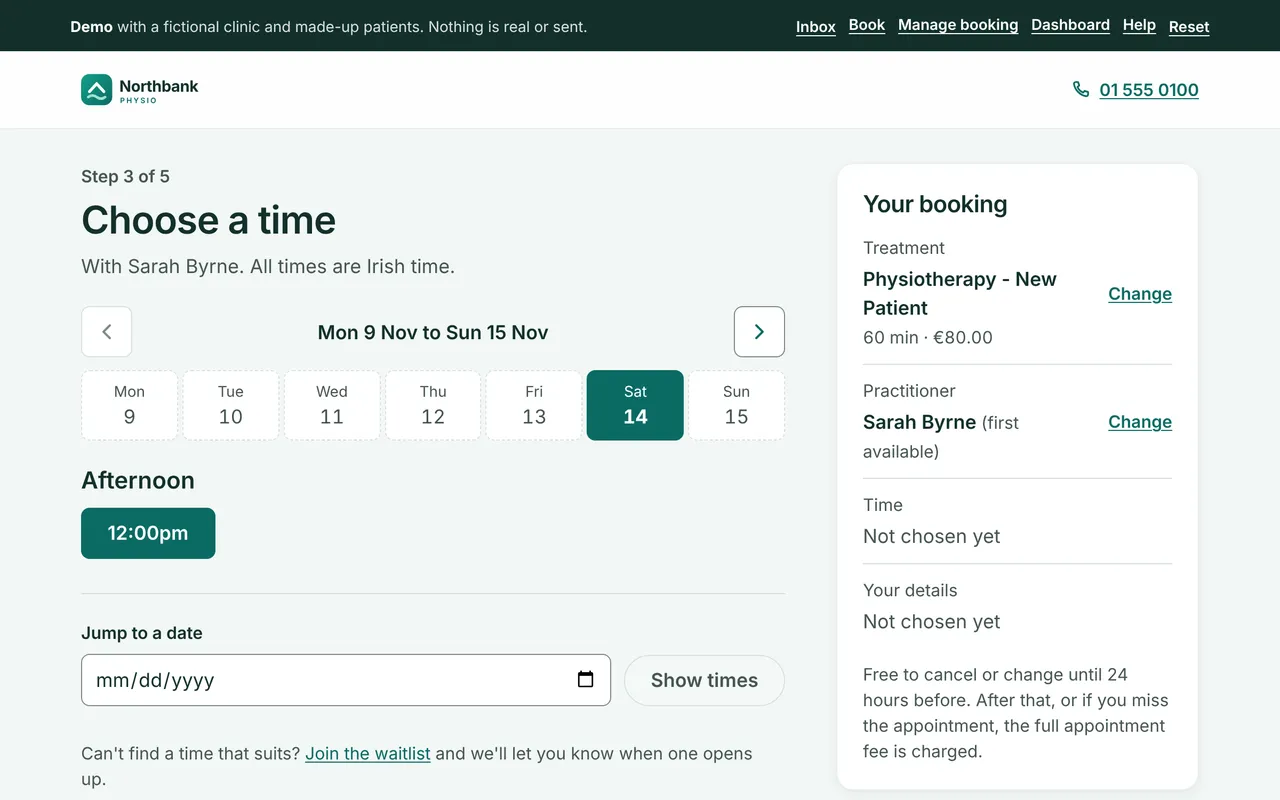
Booking, on the patient’s side
Five steps: treatment, practitioner, time, details, payment. The time is re-checked against the diary and held while they pay.
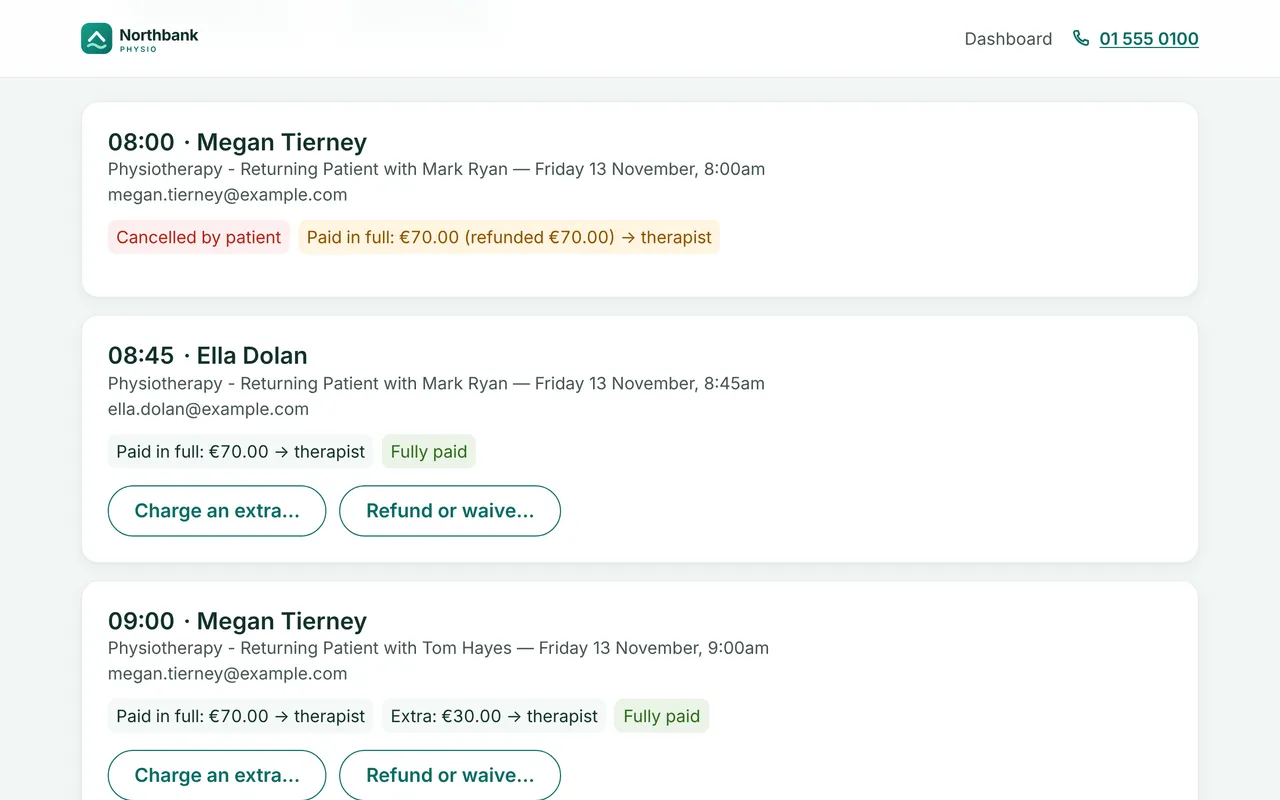
Online bookings, on reception’s side
Every online booking with its payment beside it. Reception can charge an extra, refund or waive a fee, and every action is logged.
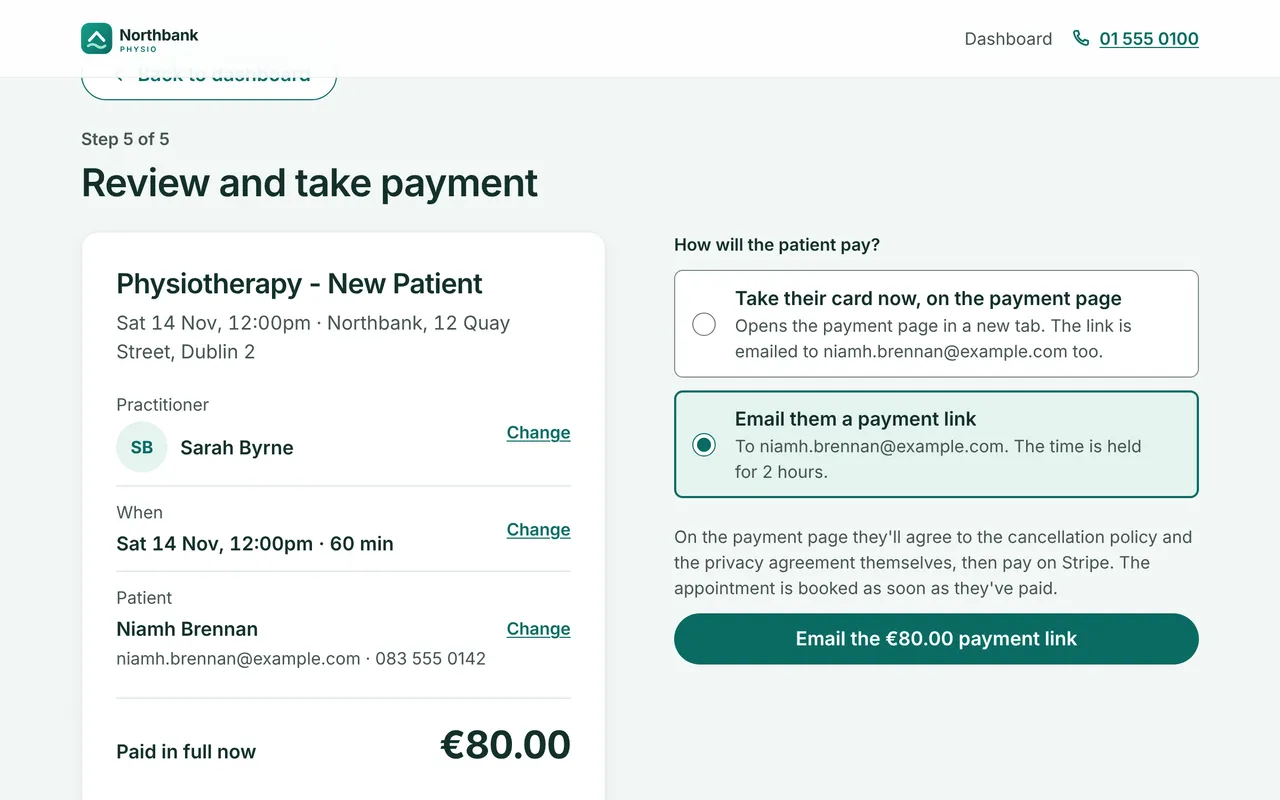
Phone booking and a pay link
Reception takes the caller through the same five steps, then takes their card on the call or emails a pay link. The time is held for 2 hours.
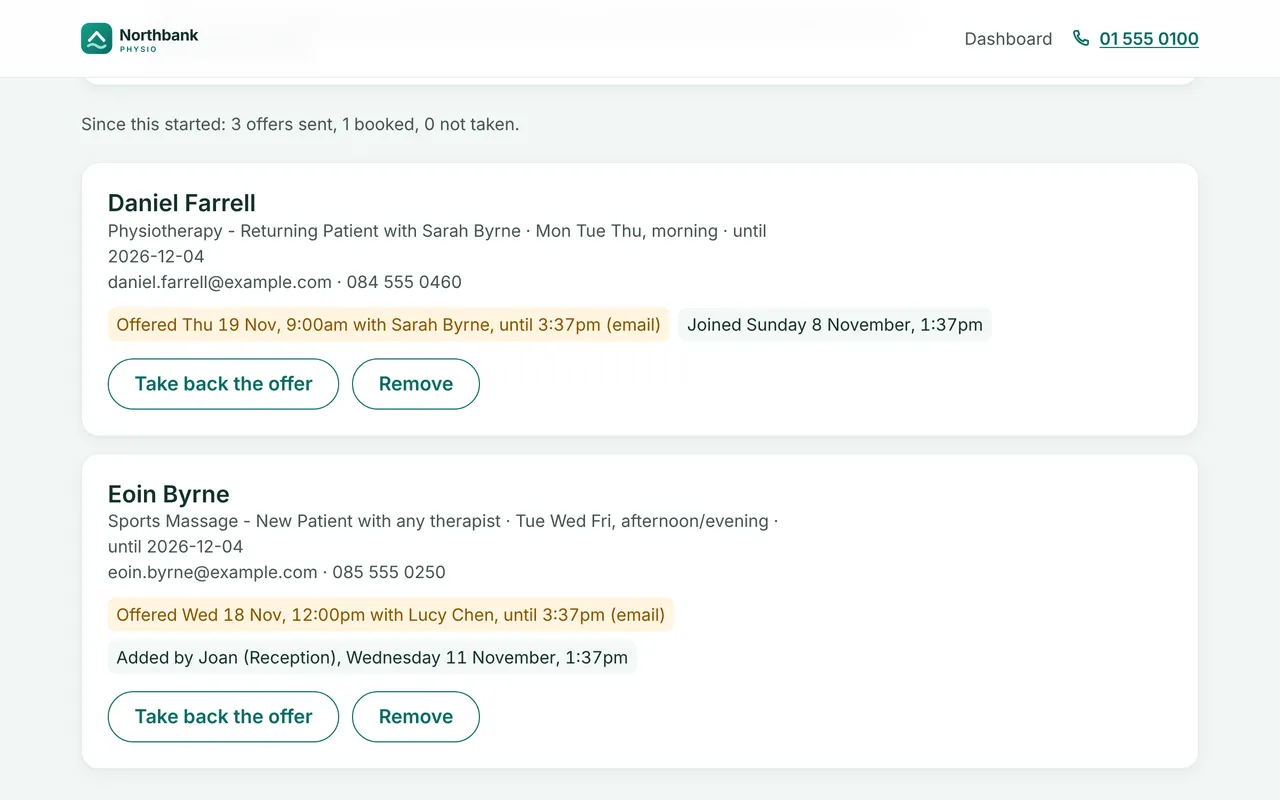
Waitlist
Patients waiting for a time. When one opens that suits them they get a link to book it, held for 2 hours. If they don’t take it, it goes to the next person.
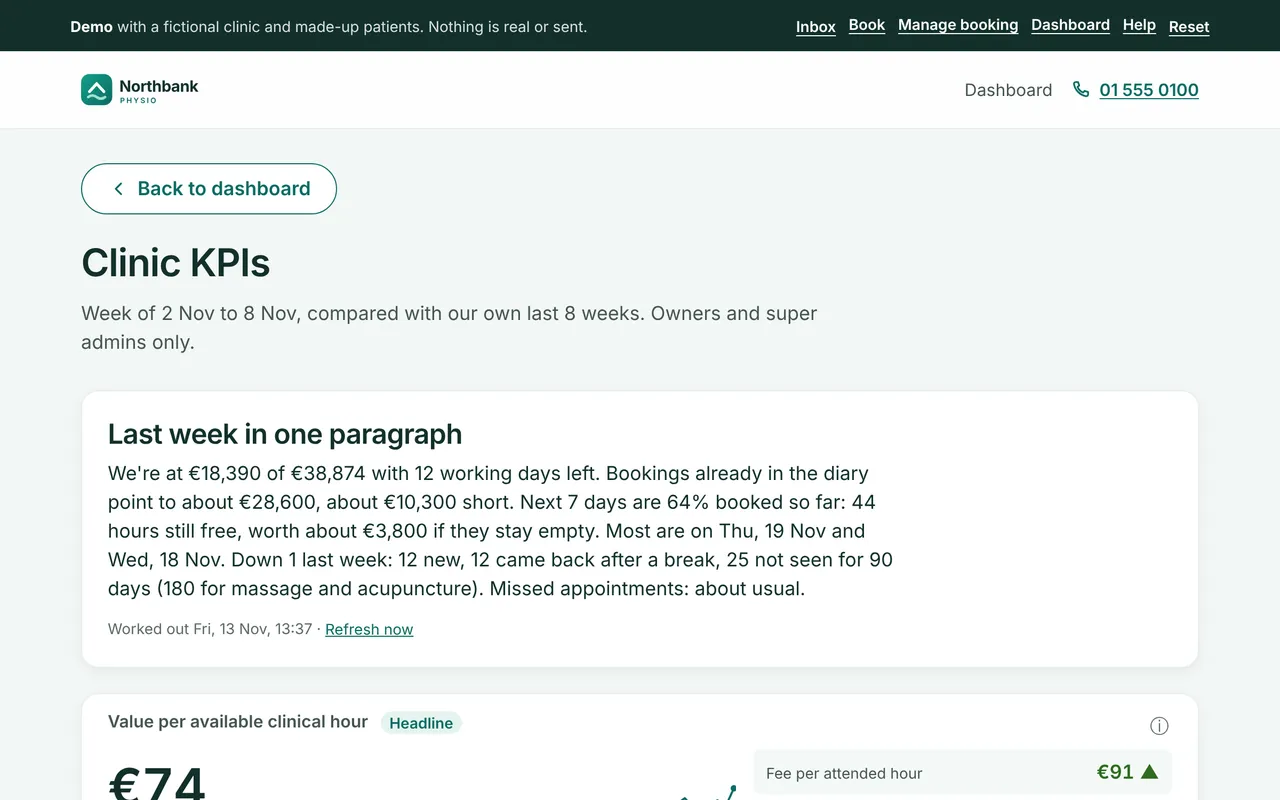
KPI dashboard
Last week against the clinic’s own last 8 weeks, starting with one paragraph in plain English. The figures here are invented for the demo.
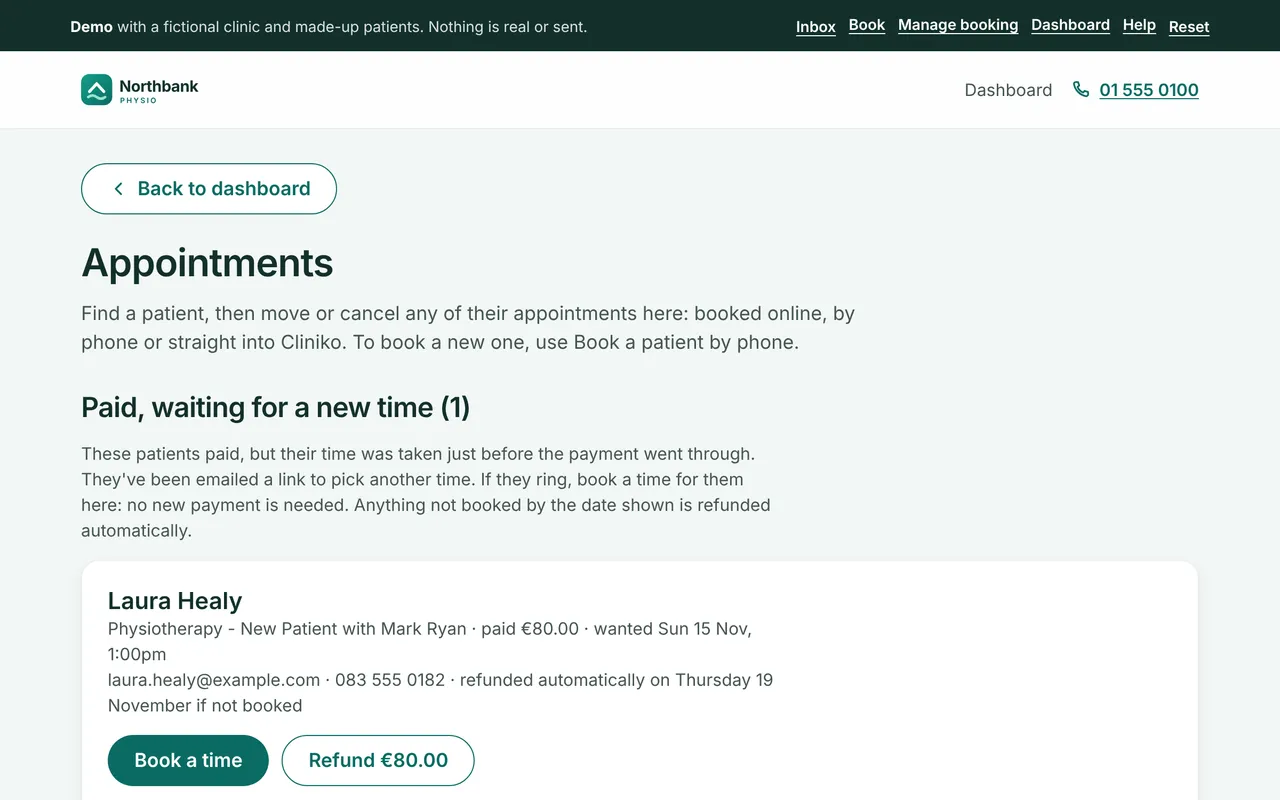
Appointments, and rebook or refund
Find any patient and move or cancel their appointments. Anyone who paid but lost their time is listed here, with Book a time and Refund beside them.
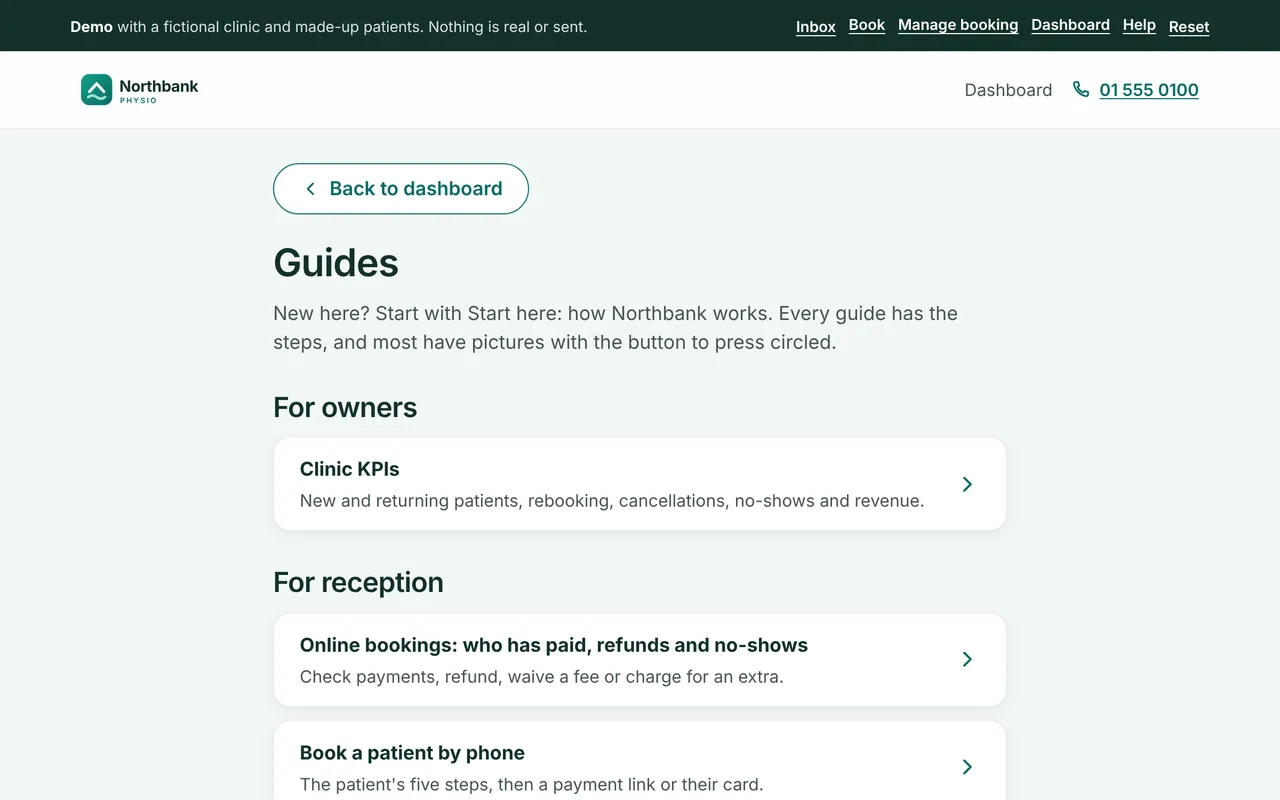
Help centre
Guides for owners, reception, staff and patients. Every guide has the steps, and most have pictures with the button to press circled.
The demo still shows the earlier, card-based treatment picker. The live site has used dropdowns since 12 November 2026.
Architecture
Patients and staff use one application, and it talks to the service that owns each job.

How it shipped
Planned from August 2026. The first piece shipped on 25 September, and the clinic went live five weeks later.
- AugPlanned from August 2026
- Booking site
- Manage booking
- Pay links
- Staff dashboard and help centre
- Guides, timesheets, approved devices
- KPIs, tasks, “not invoiced yet”
- Waitlist
- Therapist stats, and invoices (built)
- Vouchers
- Machine clashes, and go-liveGo-live
- Shifts, email templates, appointments and rebook
- Past-appointment payments
- Returning patients skip the form
- Dropdown menu live
Deep dives
Four problems where the obvious answer was wrong, or not available.
Paying self-employed therapists directly
- The problem
- The therapists are self-employed. A payment for an appointment with one of them is their money, not the clinic’s, so it has to reach their own account.
- Options considered
- What I chose, and why
- Direct charges on each therapist’s own Stripe account. Stripe refused Express accounts that pay their own fees, which ruled that option out.
- The trade-off
- A saved card belongs to one therapist’s account, so saved cards work per therapist. A refund bug needed a fix, and then a repair of older records.
Never selling one time twice
- The problem
- The Hub, clinic staff and the answering service can all book the same slot, and Cliniko has no webhooks and no locking.
- Options considered
- What I chose, and why
- Pay, then book from Stripe’s webhook, with short-lived holds, a HELD block in the diary, a re-check after payment, and rebook or refund if the time has gone. “Authorise, book, capture” came too late before launch, and authorisations only last about 7 days.
- The trade-off
- A patient can pay for a time that someone else takes a moment later, so the Hub has to put that right by itself. A fix on 4 November 2026 closed a gap where a crash in the middle of a booking could leave it unfinished.
Hold the slot
Before the patient pays, the server re-checks the time with the diary and holds it for 30 minutes, so two people can’t pay for the same slot. Phone pay links and waitlist offers hold a time for 2 hours.
Take payment
Stripe Checkout, with the card saved for the cancellation policy. Every call that moves money carries an idempotency key.
Claim the webhook event
Stripe retries webhooks. Each event is claimed once.
Seen before. Nothing changes. One appointment, one charge.
Re-check the slot
Someone may have booked it by phone while the patient paid.
Slot gone. Payment kept. Link to pick another time, refunded automatically after 7 days.
Look before creating
If an earlier attempt already made the appointment, use that one instead of making a duplicate.
Diary down. Stripe retries for up to two hours. Then a full refund, an email, and an alert to the clinic.
Confirm
Save the booking record, send the confirmation. The page polls for this status.
A fair waitlist without webhooks
- The problem
- Cliniko has no webhooks, so nothing tells the Hub when a time opens up. When one does, more than one patient may want it.
- What I chose, and why
- The Hub checks for open times every 5 minutes in working hours and offers each one to one person at a time. The rules below decide who, and when.
- The rules
- Order
- A patient waiting for a named therapist first, then whoever has gone longest without an offer, then whoever joined first.
- Offer window
- 2 hours, and it always closes 60 minutes before the slot.
- Short notice
- No automatic offers under 3 hours’ notice.
- Texts
- Only between 08:30 and 20:00.
- Limits
- 2 places on the list, 1 offer a day and 4 a week. Paused after 3 offers not taken. A place expires after 60 days.
- At checkout
- The slot is held while they pay.
- Paid but gone
- Rebook, or an automatic refund after 7 days.
- The trade-off
- Checking every 5 minutes means a freed time can wait a few minutes before anyone hears about it, and a time less than 3 hours away is never offered automatically.
Sign-in strong enough for refunds, on any laptop
- The problem
- Staff can refund patients, so sign-in has to be strong. But not every laptop in the clinic has Face ID.
- What I chose, and why
- Passkeys, plus approved computers for a laptop with no Face ID. A new browser waits for an approver, so access to someone’s inbox alone can’t move money.
- The trade-off
- A new computer can’t be used until someone approves it.
How I built it
Built with AI coding tools. I owned the product decisions with the clinic, the architecture (8 written decision records), reviewing and testing every change, and running it in production.
Before launch I wrote the requirements, a failure modes and effects analysis of everything that could go wrong with money and bookings, a test plan, a go/no-go checklist and a runbook. Every requirement has an ID, and the unit test that proves it is named after that ID, so each requirement traces straight to its test. The production code is private because it is tied to the clinic’s accounts.
Where it stands
- Live since 30 October 2026, taking real bookings and payments every day at book.bodymed.ie.
A fuller before and after, including no-shows and late cancellations, follows after about two months of data.
The rest of the suite
Four tools built for BodyMed Healthcare. The public demos run as a fictional clinic, Northbank Physio, with made-up patients and data.
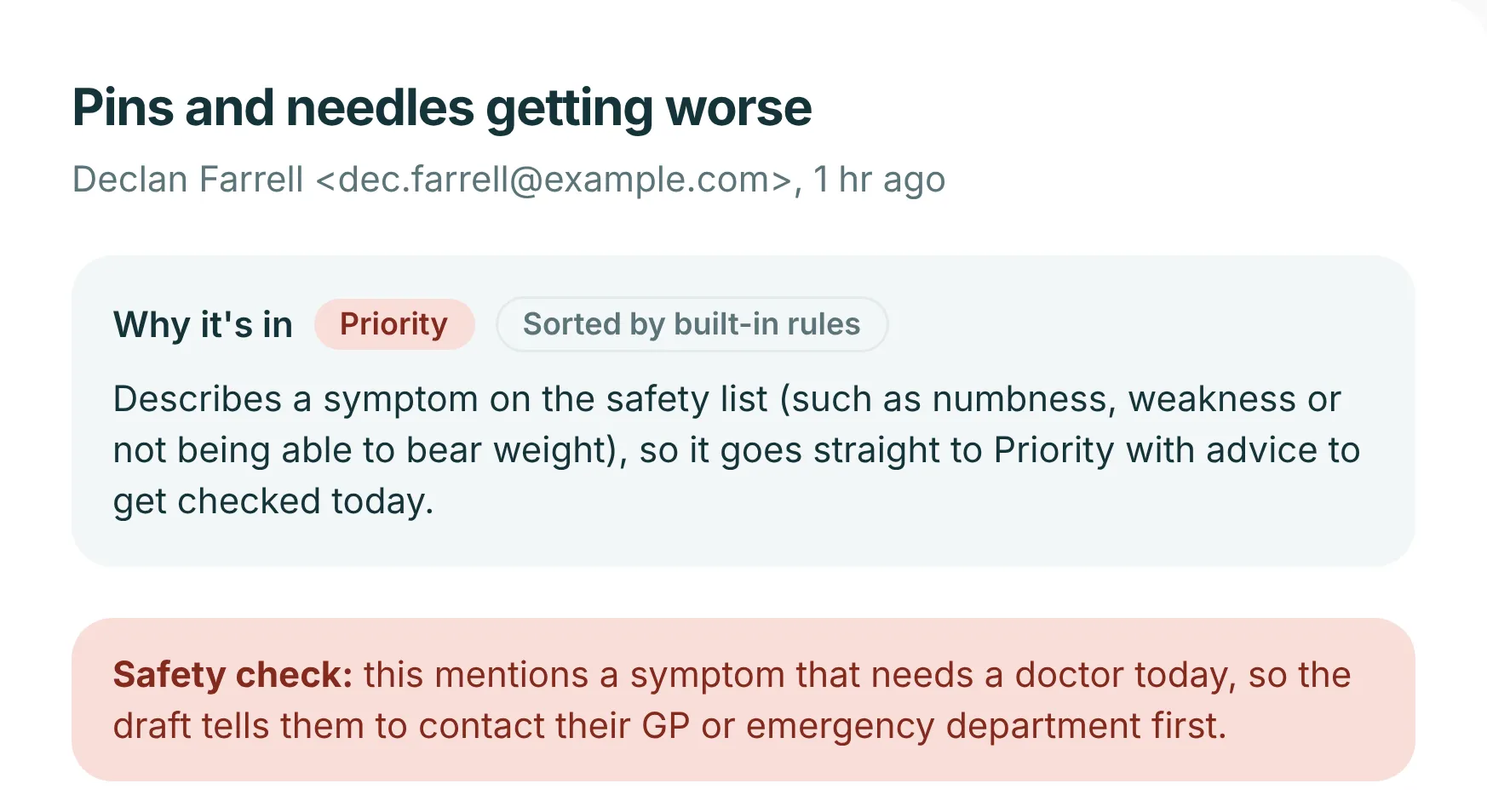
AI email triage
A prototype that sorts a clinic inbox, drafts replies and learns from staff edits.
Read the case study: AI email triage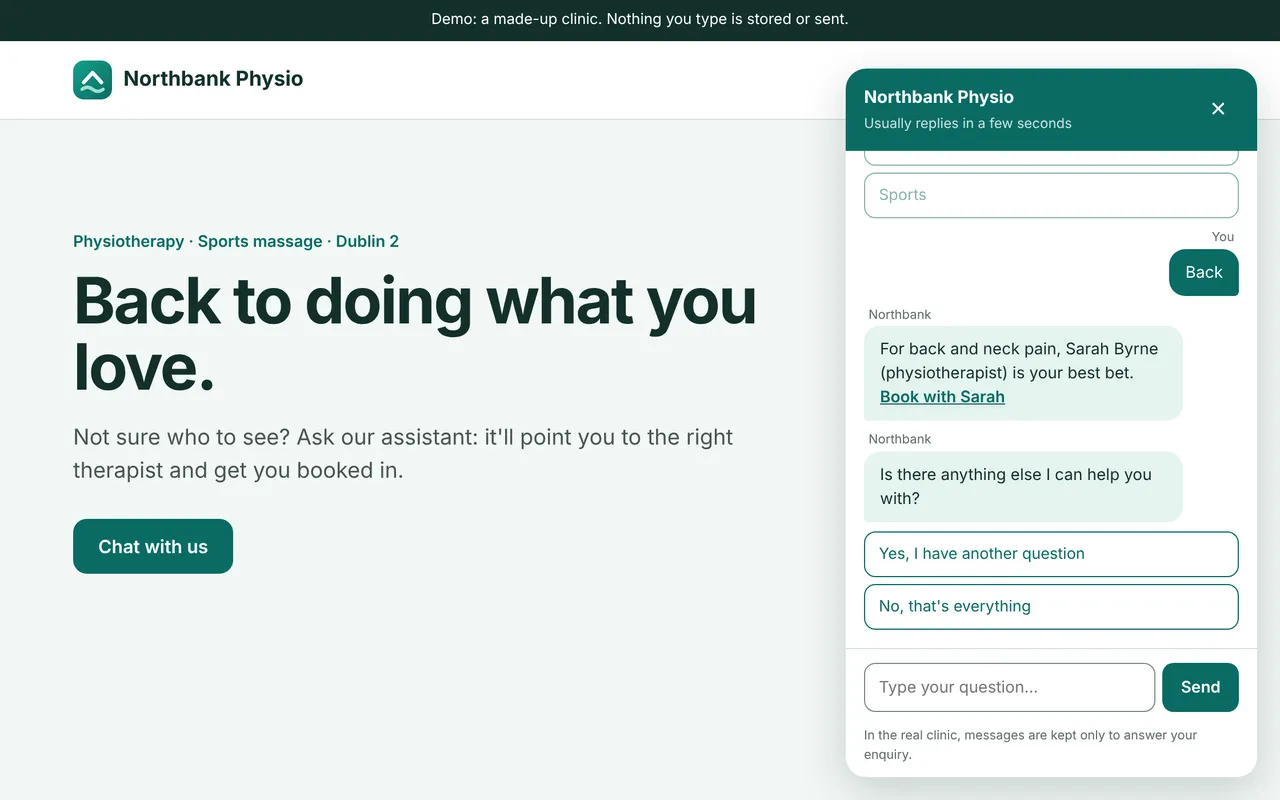
Clinic chatbot
Answers common questions and points patients to the right physio.
Try the demo: Clinic chatbot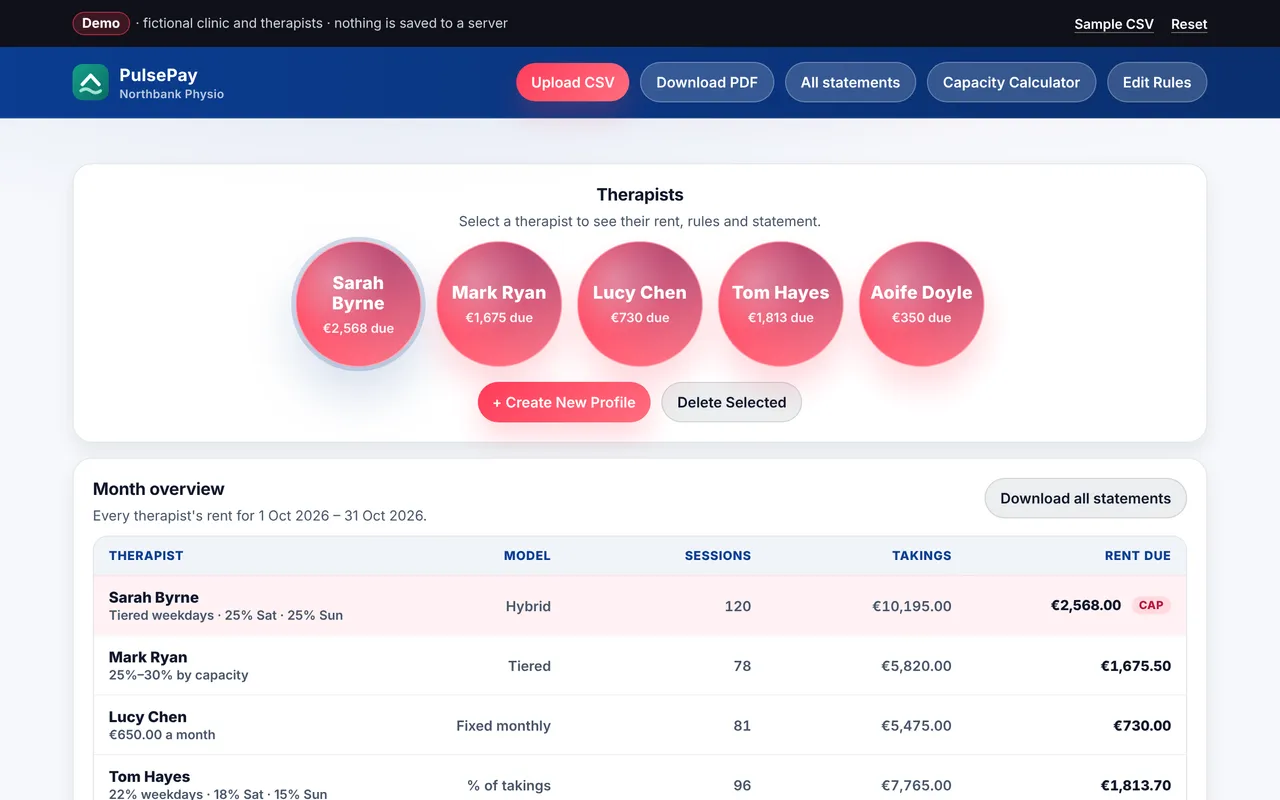
PulsePay
Monthly rent statements for self-employed therapists.
Try the demo: PulsePay
Reflection
The first version refunded a patient straight away when their slot was taken while they paid. Patients preferred not having to pay twice, so since 3 November 2026 the payment is kept and they choose another time instead.
The dropdowns taught me the bigger lesson: the people who use a system every day know the job better than I do.
About twelve weeks from first plans to launch was tight for something a working clinic depends on every day.